Quick Answer (2026 Starting & Top Scale)
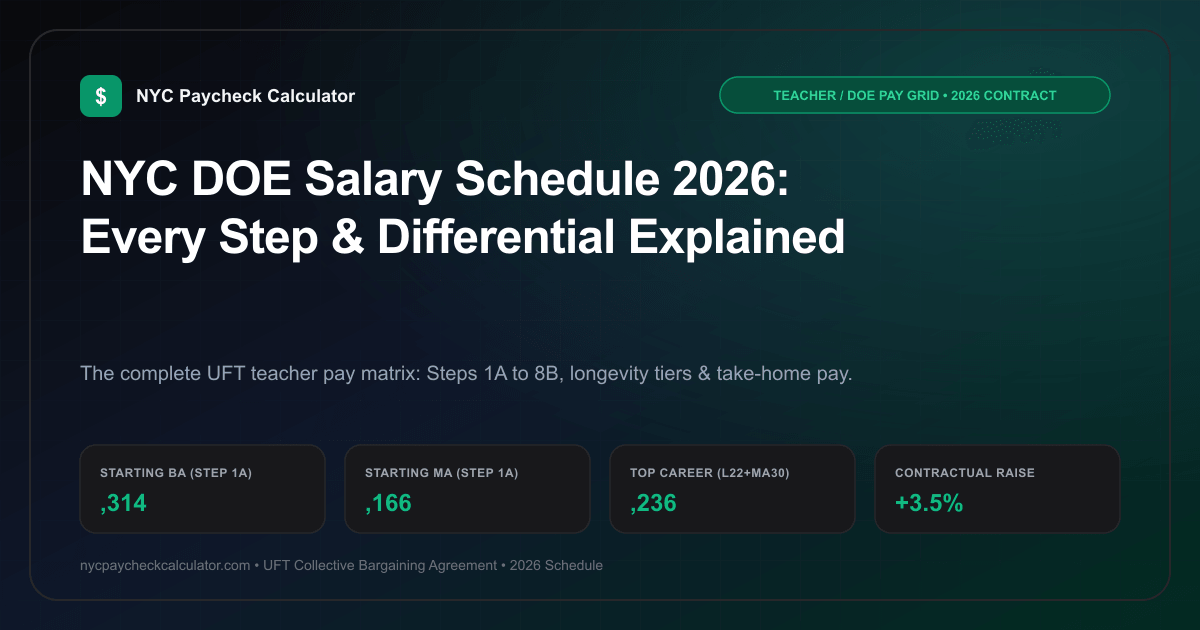
The NYC DOE salary schedule determines public school teacher earnings using a contractual grid combining experience steps and educational differentials under the UFT collective bargaining agreement. In 2026, starting salaries reach $71,314 for a bachelor's degree and $80,166 for a master's degree, advancing to $150,236 with top differentials and 22-year longevity. Compare this against housing eligibility in our NYC teacher salary & affordable housing analysis.
How Does the NYC DOE Salary Schedule Work?
The NYC DOE salary scale functions as a two-dimensional grid. Your vertical position is determined by your credited experience (Salary Steps), while your horizontal column is determined by your verified educational credentials (Salary Differentials). Every teacher sits at the exact intersection of these two coordinates. For full details on qualification rules, see our dedicated UFT salary differentials guide and UFT contract schedule.
Because the schedule is citywide, two educators with identical step and differential placements receive the exact same base pay, regardless of whether they teach in a high-need elementary school in the South Bronx or a specialized high school in Lower Manhattan.
Steps vs. Differentials: The Two Coordinates
Salary Steps (Vertical Progression):Steps measure your continuous years and semesters of approved pedagogical service. Steps are numbered from 1 through 8, with each numerical year divided into an "A" semester (fall) and a "B" semester (spring). Satisfactory service automatically moves an educator two steps forward each school year until they reach the top base tier at Step 8B.
Salary Differentials (Horizontal Progression):Differentials measure post-secondary educational attainment beyond a standard bachelor's degree. Moving horizontally across columns requires documenting graduate coursework, state certifications, or higher degrees through the NYCPS Salary Application System.
Step Progression Timing: When Do Increases Occur?
Salary step increases do not occur only once a year. Teachers advance through the schedule semi-annually on two specific anniversary benchmarks:
- Fall Step Increase (September): Reflects completed service from the preceding spring term.
- Spring Step Increase (March 1): Moves eligible educators from an "A" step to a "B" step based on fall semester completion.
Complete 2026 NYC DOE Teacher Salary Schedule Matrix
The table below outlines base annual salaries under the UFT collective bargaining agreement, incorporating the contractual 3.5% wage increase effective September 14, 2026.
| Step / Service | BA Baseline (C1) | BA+30 (C2) | Master's (C2+PD) | MA+30 / Max |
|---|---|---|---|---|
| Step 1A (Year 1, Term 1) | $71,314 | $73,708 | $80,166 | $82,563 |
| Step 1B (Year 1, Term 2) | $71,314 | $73,708 | $80,166 | $82,563 |
| Step 2A (Year 2, Term 1) | $73,385 | $75,779 | $82,237 | $84,634 |
| Step 2B (Year 2, Term 2) | $73,385 | $75,779 | $82,237 | $84,634 |
| Step 3A (Year 3, Term 1) | $75,456 | $77,850 | $84,308 | $86,705 |
| Step 3B (Year 3, Term 2) | $75,456 | $77,850 | $84,308 | $86,705 |
| Step 4A (Year 4, Term 1) | $77,527 | $79,921 | $86,379 | $88,776 |
| Step 4B (Year 4, Term 2) | $77,527 | $79,921 | $86,379 | $88,776 |
| Step 5A (Year 5, Term 1) | $80,491 | $82,885 | $89,343 | $91,740 |
| Step 5B (Year 5, Term 2) | $80,491 | $82,885 | $89,343 | $91,740 |
| Step 6A (Year 6, Term 1) | $83,455 | $85,849 | $92,307 | $94,704 |
| Step 6B (Year 6, Term 2) | $83,455 | $85,849 | $92,307 | $94,704 |
| Step 7A (Year 7, Term 1) | $87,313 | $89,707 | $96,165 | $98,562 |
| Step 7B (Year 7, Term 2) | $87,313 | $89,707 | $96,165 | $98,562 |
| Step 8A (Year 8, Term 1) | $92,265 | $94,659 | $101,117 | $103,514 |
| Step 8B (Max Base Step) | $98,198 | $100,592 | $107,050 | $109,447 |
| + 5-Yr Longevity (L5) | $103,233 | $105,627 | $112,085 | $114,482 |
| + 10-Yr Longevity (L10) | $109,278 | $111,672 | $118,130 | $120,527 |
| + 13-Yr Longevity (L13) | $114,323 | $116,717 | $123,175 | $125,572 |
| + 15-Yr Longevity (L15) | $119,368 | $121,762 | $128,220 | $130,617 |
| + 18-Yr Longevity (L18) | $123,404 | $125,798 | $132,256 | $134,653 |
| + 20-Yr Longevity (L20) | $127,440 | $129,834 | $136,292 | $138,689 |
| + 22-Yr Longevity (L22) | $132,485 | $134,879 | $141,337 | $150,236 |
Longevity Increments: Scaling Beyond Step 8B
Standard step increments conclude once an educator completes Step 8B. From that point onward, raises are awarded through longevity increments earned at milestone anniversaries of continuous service in NYC public schools:
- 5-Year Longevity (L5): Adds approximately $5,035 to base compensation.
- 10-Year Longevity (L10): Adds another $6,045 to annual base pay.
- 13, 15, and 18-Year Milestones: Protect salary progression against inflation.
- 20 and 22-Year Longevity (L22): With top differential (MA+30), reaches the maximum contractual base of $150,236.
Understanding Salary Differentials: How Credits Increase Base Pay
While steps reward longevity, salary differentials reward professional education:
- First Differential (C2 / BA+30): Requires 30 approved credits beyond a bachelor's degree. Adds $2,394 to starting base pay.
- Promotional Differential (C2+PD / Master's): Completing an approved master's degree raises starting pay from $71,314 to $80,166—an immediate $8,852 annual raise.
- Second Differential (MA+30 / C2+ID+PD): 30 graduate credits beyond a master's (with at least 18 A+ credits). Provides the highest salary column on the grid.
From Gross Salary to Real Take-Home Pay in NYC
While your contract lists gross compensation, federal, NY State, NYC local resident taxes, and pension deductions determine what lands in your bank account.
| Tax / Deduction | Step 1A BA ($71,314) | Step 1A MA ($80,166) |
|---|---|---|
| Federal Income Tax | -$6,859.08 | -$8,806.52 |
| New York State Tax | -$3,253.96 | -$3,731.96 |
| NYC Resident City Tax | -$2,329.22 | -$2,672.32 |
| FICA (Social Security & Medicare) | -$5,455.52 | -$6,132.70 |
| Annual Net Take-Home Pay | $53,416.22 | $58,822.49 |
| Bi-Weekly Paycheck (26 checks) | $2,054.47 | $2,262.40 |
For an in-depth breakdown of early-career vs. veteran take-home pay, per-session tutoring earnings, and borough rent affordability, read our companion guide on How Much Do NYC Teachers Make in 2026?
Run your own DOE salary in the calculator
Enter your exact step, differential, filing status, and TRS retirement deductions to see your personalized net paycheck.
Frequently Asked Questions
What is the starting salary for an NYC DOE teacher in 2026?
Under the current UFT contract with the 3.5% wage increase effective September 14, 2026, a new NYC DOE teacher starts at $71,314 with a bachelor's degree and no experience (Step 1A). A new teacher holding a master's degree starts at $80,166.
How often do NYC teachers move up a salary step?
NYC DOE teachers advance two salary steps per school year under standard satisfactory performance. Increases take effect semi-annually: once in September for the fall semester and once on March 1 for the spring semester.
What is the difference between a step and a differential?
A salary step reflects your years of credited teaching experience and moves you vertically down the salary grid. A salary differential reflects your academic degrees and post-graduate credits, moving you horizontally across columns to higher base compensation.
What is the highest salary an NYC teacher can make on the schedule?
The maximum contractual base salary on the NYC DOE schedule is $150,236. Reaching this top tier requires achieving 22 years of continuous public school service (L22 longevity) combined with the highest educational differential column (Master's + 30 approved credits).
Can outside teaching experience count toward my salary step?
Yes. Newly appointed NYC public school teachers can claim up to 7.5 years of verifiable prior outside teaching experience from accredited schools. If approved through the Salary Application System, an educator can start as high as Step 8A.
What are A+ credits, and why are they required for the MA+30?
A+ credits are specialized professional development courses approved by the NYC Department of Education. For teachers hired on or after September 1, 2017, at least 18 of the 30 graduate credits required for the Second Differential (MA+30) must be approved A+ courses.
How does the NYC Teachers' Retirement System (TRS) affect take-home pay?
Under TRS Tier 6, pedagogical employees contribute between 3% and 6% of their gross annual wages based on their salary tier. Because TRS pension contributions are pre-tax deductions, they reduce your federal, state, and city taxable income while lowering your net take-home paycheck.
Does where you teach in NYC change your salary schedule?
No. The NYC DOE operates on a single, unified salary schedule across all five boroughs (Manhattan, Brooklyn, Queens, the Bronx, and Staten Island). Every school follows the identical UFT contract rates regardless of zip code or district.
What happens if I miss the 6-month deadline for a salary differential application?
If you submit your application after the six-month deadline from completing your credits, your salary increase will only take effect from the date your application is received. You will lose the ability to collect retroactive back pay for the preceding months.
Where can I check my current salary step and differential status?
You can confirm your current step and differential on your bi-weekly DOE pay stub (pay advice slip) via NYCAPS, or by utilizing the UFT Salary Checkup Tool located in the official UFT Member Hub.